What to Say When Your Boss Won't Make a Decision
Your boss says “use your judgment,” then questions the judgment you used. Here’s how to move the work forward when the decision, and the authority to make it, are unclear.


There is a particular kind of workplace conversation that sounds productive until you try to act on it.
You explain that the new request will affect the deadline. Your boss nods. You lay out two reasonable ways forward. They say, “Use your judgment.”
So you do. Then, when the work is nearly done, they ask why you didn’t choose the other option.
The problem was never that you lacked judgment. It was that nobody settled who had the authority to make a choice with consequences for the deadline, the budget, or another team’s work.
When your boss won’t make a decision, asking the same question more politely usually gets you another version of the same nonanswer. What helps is making the choice small enough to answer, showing what happens if it stays open, and finding out whether “use your judgment” actually means the decision is yours.
Why “use your judgment” can be so confusing
Sometimes it is a genuine vote of confidence. Your manager trusts you to choose an approach and live with the ordinary tradeoffs.
But those three words can also hide a disagreement. Your boss may want the faster deadline and the added work. They may be waiting for someone above them. They may have a preference they haven’t shared. Or they may not realize that the choice they consider minor changes a promise you have already made to someone else.
You cannot know which it is from the phrase alone.
Imagine you are preparing a client deliverable due Thursday. On Monday, your boss asks you to add a new section. You estimate that the addition will take two more days. If you ask, “What should I do?” they can easily answer, “Do your best.”
But “do your best” does not tell you what to say when the client asks whether Thursday is still the date.
The conversation needs to move from effort to choice:
“I can deliver the agreed version Thursday, or add the new section and send the expanded version Tuesday. Which date and scope should I tell the client to expect?”
Now the tradeoff is out in the open. Your manager can choose either path, suggest a third, or tell you who else needs to approve it.
Make a recommendation they can respond to
Managers often expect you to arrive with a point of view. That is fair. You know the work, and your recommendation may make the decision easier.
You might say:
“I recommend sending the agreed version Thursday and scheduling the new section for the next delivery. That protects the date we gave the client. If you’d rather include it now, I’ll need to update the date.”
This sounds different from pushing the problem back onto your boss. You have assessed the options and said what you think should happen. You are asking them to own the part of the choice that belongs to their role.
Be candid about estimates. If Tuesday depends on another team, say so. If removing a different task would make Thursday possible, mention it. The point is to give your manager a realistic picture, even when that picture is inconvenient.
And if neither option works for them, invite a concrete alternative:
“If we need the new section and the Thursday date, what should come out of the current scope, or who can help with the additional work?”
That question is useful because it turns “we need everything” into a discussion about resources and priorities.

Find out what your boss is actually giving you permission to decide
Suppose your boss says, “I hired you to make these calls.”
You may be perfectly comfortable choosing how to structure a report or solve a technical problem. That does not necessarily mean you can change a client commitment or spend more money. You can ask about the boundary without sounding helpless:
“I can choose the approach. Are you also asking me to decide whether we move the client deadline, or do you want to approve that change?”
If they say the entire choice is yours, confirm what you intend to do:
“Okay. I’ll keep the Thursday date and move the new section to the next delivery. I’ll update the project plan today.”
If they say they want to approve the deadline, you have your answer about ownership, even if you do not yet have the decision itself.
This distinction matters. Plenty of people are told to “take ownership” of work while having little control over staffing, priorities, or promises made by leadership. You can own your recommendation and execution. You still need to know who owns the commitments those choices affect.
Give the decision a deadline that means something
A message that says “Please advise when you can” can sit unanswered for days. A useful deadline explains when the work begins to change.
“I can finish the parts both versions need this morning. To keep Thursday possible, I need the scope choice by 3 p.m. After that, I’ll have to revise the delivery estimate.”
Three o’clock is not a threat here. It is the point when you must start one path or the other.
You do not need to pretend every decision is urgent. If you can keep working until tomorrow without losing time, say that instead. But once delay has a consequence, name it while there is still time to do something about it.
Follow up without writing a courtroom exhibit
After a meeting, put the decision in the place your team uses to manage the work. That might be an email, a project ticket, or a shared document. The note can be short:
“Following up on today’s conversation: I recommend delivering the agreed scope Thursday and moving the new section to the next delivery. Including the new section now would move my estimated date to Tuesday. I’ll work on the shared pieces today. Please confirm which scope we’re using by 3 p.m. so I can give the client an accurate update.”
This is not about catching your manager in a mistake. It is about giving everyone the same plan.
If your boss already chose an option, write that instead: “Confirming that we’re delivering the agreed scope Thursday.” A recap should clarify a decision, not reopen it by accident.
What if they still won’t answer?
Work on whatever will be useful under either option. Once you reach the point where the paths split, say what is finished and what is waiting.
“The shared work is complete. The added section is waiting on the scope decision. Since we did not have that choice by 3 p.m., I can’t confirm Thursday for the expanded version. The original scope is still on track.”
Notice what this does. It gives an accurate status without claiming that silence means approval. It also avoids quietly absorbing the delay and reporting the project as on track when it no longer is.
If a choice affects a customer promise, budget, compliance requirement, or another team’s capacity, use your organization’s normal route to get it to someone who can decide. You can frame that request around the work:
“We need a scope decision today to communicate the right date. Who can approve whether the new section moves into this delivery?”
That is a reasonable question to ask before the deadline slips, especially when you do not have the authority to make the change yourself.
What if they change their mind after you start?
Managers are allowed to change priorities. What creates trouble is acting as though the change has no cost.
If you spent two days on the first direction and are now being asked to take the other one, pause long enough to reset the plan:
“We began the Thursday version after Monday’s discussion. I can switch to the expanded version. Some of the work won’t carry over, so I’ll revise the estimate and update the team. Can you confirm that the expanded version is now the priority?”
Keep the written record current. Someone looking at the project later should be able to tell which direction the team was following at each point and what changed. You do not need a dramatic account of who said what. The decision and its effect are enough.
When this keeps happening
One muddled decision is an ordinary work problem. A repeated pattern can make it hard to plan anything.
If your boss regularly delegates a choice and then rejects the outcome, try asking about the rule behind their decisions:
“I want to handle these requests the way you expect. Which choices can I make on my own, and which ones do you want to review before I commit to a date or scope?”
The answer may reveal that you have more freedom than you thought. It may reveal that your manager wants to approve every external commitment. Either way, you have something more useful than “use your judgment.”
There are also workplaces where clearer wording does not lead to fairer treatment. If shifting expectations are affecting your performance review or your job security, keep an accurate record of assignments, decisions, and changes, and seek advice appropriate to your situation. No email template can guarantee that someone else will behave well.
The aim is simpler than that. Make the work visible. Make the tradeoff visible. And when a decision requires authority you do not have, make sure it reaches someone who does.
The sentence to keep handy
The next time you hear “use your judgment” while a deadline hangs in the balance, try this:
“I recommend A because it protects the current commitment. B is possible, but it changes the date. I can choose how to do the work. Can you confirm which commitment we’re making?”
It is direct without being confrontational. You have made a recommendation, shown the consequence, and asked the question that was missing from the first conversation.
Your boss may still need time to decide. At least now everyone can see which decision is waiting and what the waiting costs.
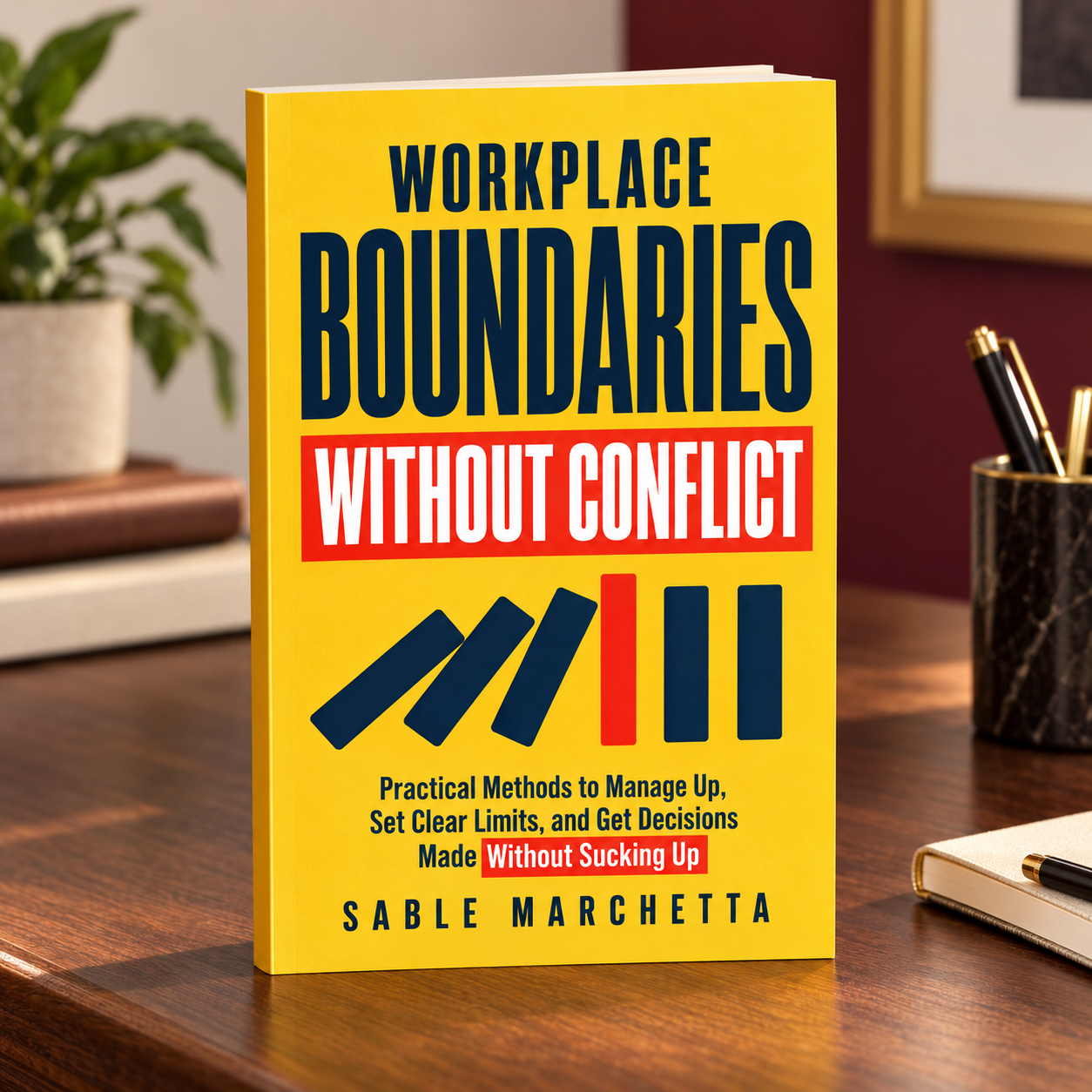
More from Sable Marchetta: If unclear priorities and last-minute requests keep landing on your desk, Workplace Boundaries Without Conflict offers more guidance on communicating limits while keeping the work moving.